Our goal is to explore the new social patterns, user behaviours, role of technology, and future experiences around the emerging societies and the connected entities (communities, societies, and environments) within an ecosystem. Our plan is to adopt, envision and conceptualize novel and innovative methods of research and design. Over multiple years of working in this field, we know that success comes through a multidisciplinary approach. We plan to utilize our strong art & design led methods of integrated innovation & experience design:
- Develop and evaluate responsible futures capability model: to explore the new social patterns, user behaviors, role of technology, and future experiences around the emerging societies that are in sustained transition and develop actionable insights and future vision concepts.
- Starting with a stake-in-the ground framework, RISE, and existing tools and drawing from critical social theory, we will continuously iterate on appropriate framework, methodology and toolkit
- Apply responsible design index developed by Apala Lahiri Chavan to evaluate our outcomes
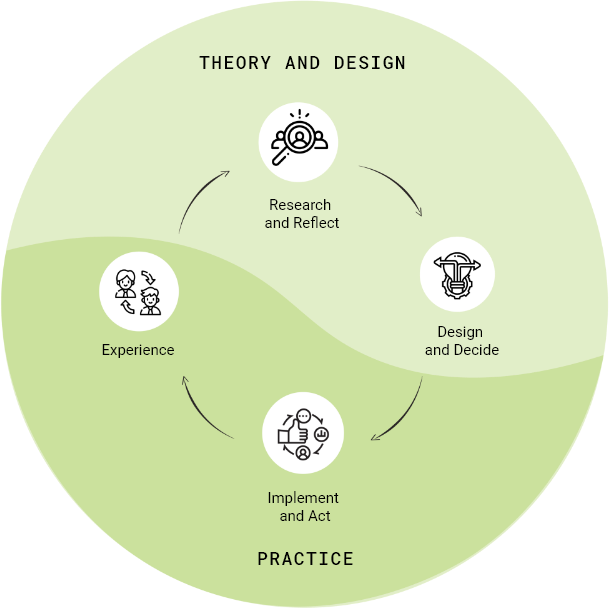
- Socialize the outcome of the project and invite like-minded people and organizations to develop Hfi.org as a responsible and equitable futures design think tank (a “do-tank”). We plan to explore frameworks, methods and processes that allows all of us to ask questions, think, and create a preferred future that is responsible and equitable. Drawing from the critical social-theory process, we want to combine various theories with practice as shown in the figure
We plan to explore frameworks, methods and processes that allows all of us to ask questions, think, and create a preferred future that is responsible and equitable. Drawing from the critical social-theory process, we want to combine various theories with practice as shown in the figure
Our Frameworks
Human Centered Design
Human Centered Design
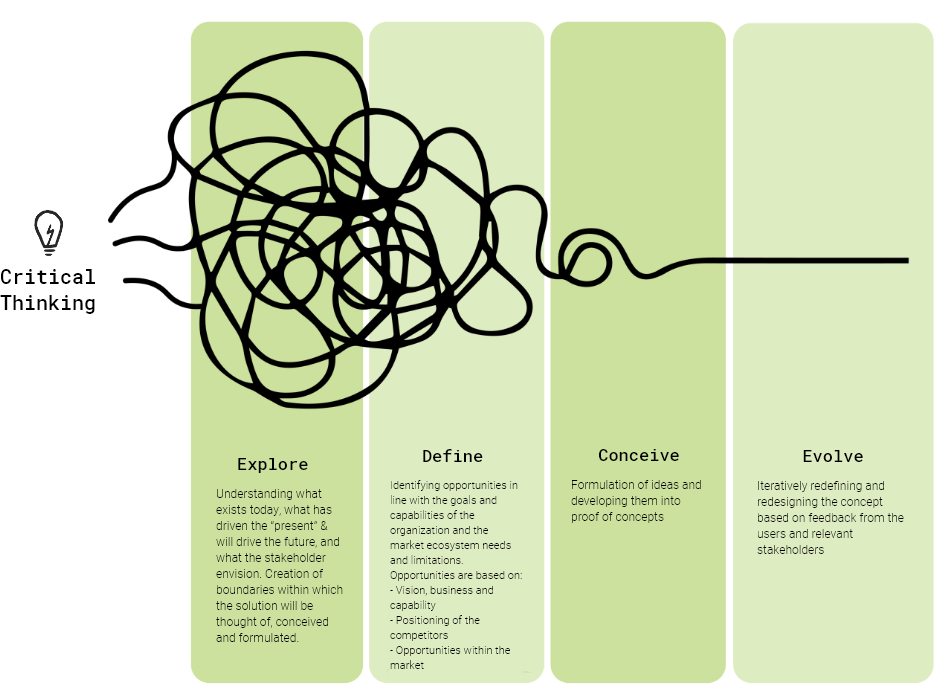
On the theoretical and design side of this equation, we want to start with principles of design thinking and an iterative human centered design as shown in the figure.
Beyond Human Centered Design
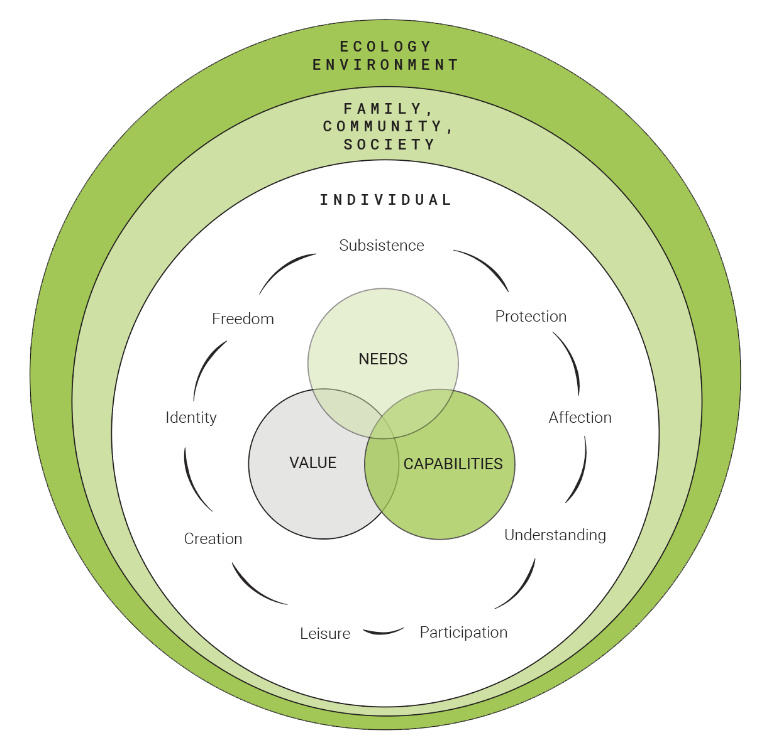
We plan to incorporate a design philosophy that goes beyond the individualist human needs based approach to include family, community and societal need. And expand it to include ecology and environment.
Beyond Human Centered Design
RISE Framework
We plan to incorporate RISE framework into this iterative multidisciplinary approach. RISE framework allows responsible & equitable design and innovation for a bigger impact. This framework not only explores desirability, feasibility and viability, but also focuses on societal/ecological impact.
RISE comprises of Responsible futures thinking, Impact analysis, Systems thinking and Ecosystem alignment. This is an iterative design process and moves a designer from a human centered approach to a humanity centered approach. We are hoping that this framework will allow “designers” and entrepreneurs to think about the impact and cost of their interventions.
This framework works both at the strategic and the tactical level. At the strategic level, we need to think about the positive impact, the global and social responsibility, culture, values, ethics, and justice. Our personal and business vision, mission, and brand has to align with these strategic objectives. At the tactical level, apart from aesthetics, usability, accessibility, we need to think about socio-cultural-technical issues, behavioral impact, materials, environmental impact, and responsible business models. In short, we have to strive to improve our understanding of the impact of our work.
Interestingly enough, we already have methods and tools such as futures and strategic forecasting, systems mapping, speculative design, persuasive and emotional design, cooperative business model innovation to name a few, that can be used to implement this approach. It just requires a mindset change.
Responsible Future
Think about a preferred future rather than a possible and probable future, combining futures methods and speculative / critical design methods.
Do we need to build more low priced cars versus invest on infrastructure and policies that promote public transportation? How can we change behaviours towards public transportation?
Impact Analysis
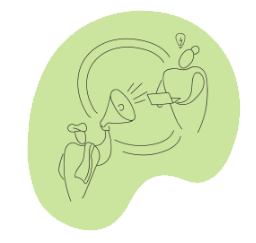
Continuously think about the impact your decisions can have on all the ecosystem stakeholders.
How does the intervention impact current cab owners, how does it impact the car manufacturers? How does it impact the current car drivers, rickshaw drivers? What are the other impacted groups?
Systems Thinking
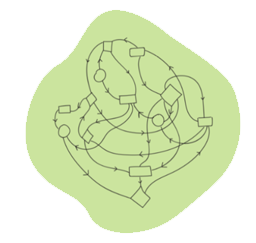
Think about the interventions as a connected network and not just a product.
Should we invest on infrastructure and policies that promotes public transportation? How do we provide last mile connectivity?
Ecosystem Alignment
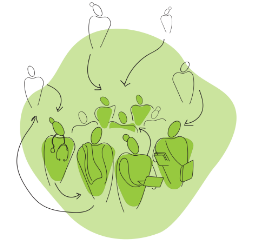
One needs to go beyond the human centred design approach of aligning only the users and business goals. Think about your community, society and the ecology. In other words, move to a humanity centered design.
Can I realign my infrastructure intervention so that it does not split the communities? Can it reduce the impact on the environment and ecology?
Theory and Design
Research Approach
We utilize critical research principles to gather insights and reflect on them. Drawing upon the principles of interpretive research and critical research, we incorporate following principles of insights, critique and transformation in our work Principles to generate Insights.
Principles to Generate Insights
- iterate between considering the interdependent meaning of parts and the whole
- Critically reflect on the social and historical background of the research setting
- Critical reflection on how the research materials (or “data”) were socially constructed through the interaction between the researchers and participants.
- Relate the idiographic details revealed by the data interpretation through the application of principles one and two to theoretical, general concepts that describe the nature of human understanding and social action.
- Sensitivity to possible contradictions between the theoretical preconceptions guiding the research design and actual findings (“the story which the data tell”) with subsequent cycles of revision.
- Sensitivity to possible differences in interpretations among the participants as are typically expressed in multiple narratives or stories of the same sequence of events under study.
- Sensitivity to possible “biases” and systematic “distortions” in the narratives collected from the participants.
Principles to Critique
- Use core concepts from critical social theorists:
- Advocate values such as open democracy, equal opportunity, or discursive ethics.
- Identify important beliefs and social practices and challenge them with potentially conflicting arguments and evidence.
Principles to Transform
- Facilitate the realization of human needs and potential, critical self reflection, and associated self-transformation.
- Suggest how unwarranted uses of power might be overcome rather than just to reveal the current forms of domination, assuming that social improvements are possible, although to very differing degrees.
- Improve the existing theories through competing truth claims, analyses and interventions
Our Design Approach
Apart from the existing design principles, we will also develop additional principles as required. For examples, based on critical theory approaches of Bourdieu, Foucault, and Habermas, we have devised following principles of equitable design
Principles of Equitable Design
- Distribution of capitals: Design to provide appropriate access to economic, social, cultural and symbolic capitals within the multidimensional social space that each individual occupies due to their social conditioning.
- Access to knowledge: Since knowledge is power, provide access to the right amount of knowledge through archaeology and genealogy of knowledge
- Self-surveillance and self-awareness: Provide various disciplinary mechanisms which regulate the behaviour of individuals, using a combination of self-surveillance and self-awareness approaches.
- Individual and mutual success: Provide a good balance as appropriate that allows cooperation through mutual understanding, and correct level of competition based on their own private goals
- Bridge the gap between internal and external world: Bridge the gap between the internal subjective viewpoint of the lifeworld experienced dure to culture, society or personality and the external systems either through design or through rational argument, at the objective, social, and subjective levels
Practice
Live Labs / Citizen Designer’s Panel
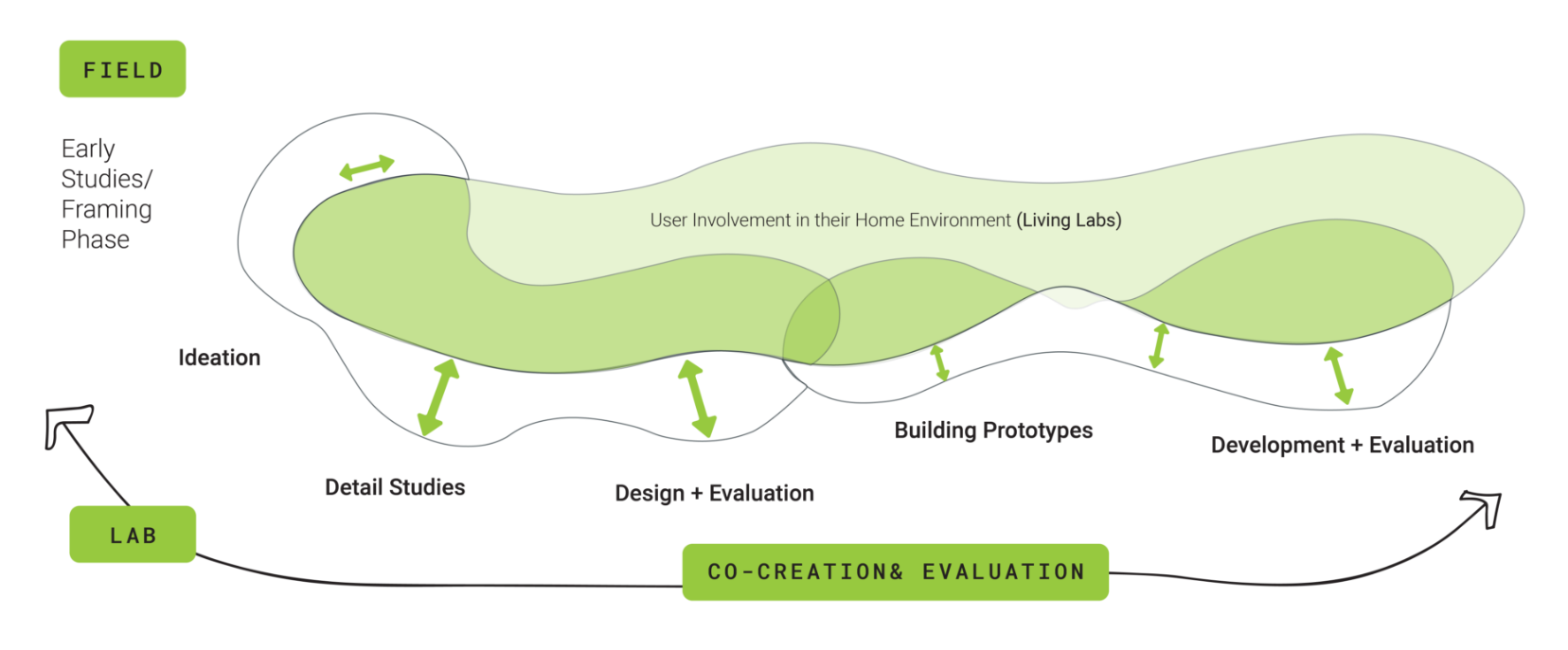
Apart from the field and center-based research & ideation agenda involving the partner(s), we propose to also create a Living Labs / Citizen Designers panel consisting of user panels, not only as an arena for co-creation but also an arena for understanding future user behaviors.
The aim of the living labs / citizen designers’ panels is to create a setting for continuous engagement in co-creation, exploration, and evaluation of novel ways of being mobile, by providing a consistent group of lead users as stakeholders in the process. We plan to design, build and utilize novel technology and services as cultural probes, very close to actual use settings. Living labs will also utilize prototyped new technologies and services to understand user behavior changes.
